
OneCasino licence and New Zealand gambling rules
 Available in US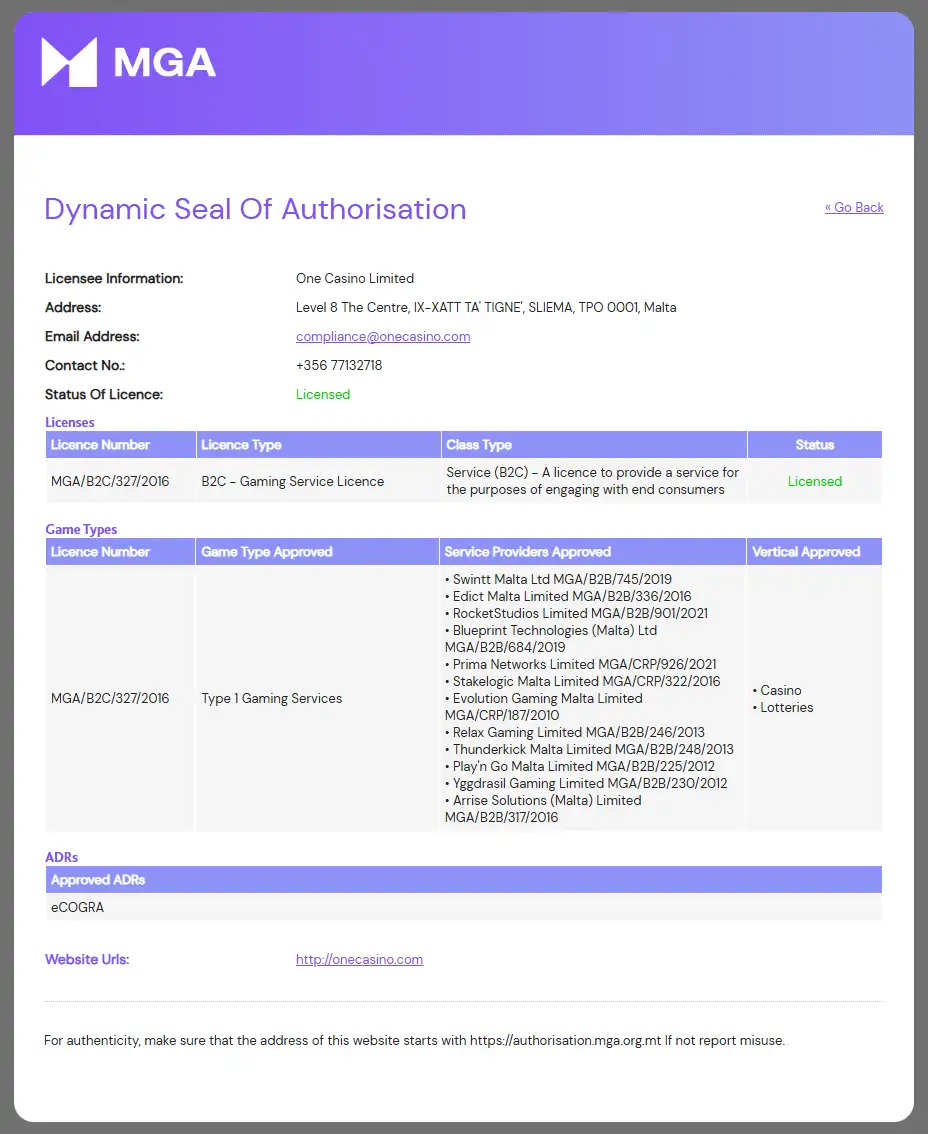
Contents
OneCasino’s international business is operated by Malta-based One Casino Limited, whose casino service appears on the Malta Gaming Authority’s public authorisation record. New Zealand has introduced its own phased online-casino regime, under which an overseas licence is not the same as permission to operate domestically. Reading the two arrangements separately makes it easier to understand the operator, the domains covered by the Malta licence and the consumer protections associated with each system.
The important New Zealand question is the statutory transition from May to December 2026 and the later licensing stages, not a blanket ban on all online casinos. A historical NZ account or an internationally recognised casino licence does not by itself determine whether access is lawful under New Zealand’s current regime. Regulatory channels and account-level issues also work differently, particularly where cash-outs and identity checks are involved.
New Zealand access during the 2026 transition
New Zealand’s Online Casino Gambling Act 2026 began operating on 1 May 2026. It creates a phased route to licensing online casino providers rather than a simple overnight switch from an unregulated market to a complete licence register. The rules distinguish businesses already serving New Zealand players before that date from businesses entering the market later. That distinction matters because an international casino can have a current overseas authorisation without automatically satisfying New Zealand’s separate transitional conditions.
Operators that were already providing online casino gambling to New Zealand customers before 1 May may continue under the Act’s transitional arrangements until 1 December 2026, subject to the statutory conditions. New entrants do not gain the same temporary permission. On 1 December the transitional position changes: continued operation is tied to the application process and the relevant exemptions while applications are considered. The authorities expect actual licences to be granted later in the process. A New Zealand licence and an overseas gaming licence therefore answer different questions.
OneCasino has historical links to New Zealand players, including earlier accounts of NZD-denominated cash-outs and international review material referring to New Zealand. Historical play, however, does not by itself decide whether an operator qualified under the Act’s transition, participated in the auction or meets the conditions for continued NZ-facing operation. OneCasino’s current legal entitlement in New Zealand is consequently not something a historic player account can determine. The relevant test is the New Zealand statutory route, not whether a foreign website loads in a browser.
The Department of Internal Affairs (DIA) administers the system. Its Online Gambling for Players guidance explains the transition and how future licensed operators will be treated. The Act envisages a public register of online casino licences, but the staged timetable means it cannot be treated as an already populated list of New Zealand licensed casinos at this point. A lack of a licence entry while no operational register has been issued has a different meaning from a failed registration check in a mature licensing regime.
For an account holder, the practical consequences concern eligibility to receive services, complaint handling and the protections that attach to an authorised operator. An overseas casino history or an account balance should never be used as a substitute for that framework. The account and identity guide explains the operator’s verification conditions separately from the New Zealand authorisation question.
The Malta licence and the covered domain
The international OneCasino business operates under One Casino Limited, registered in Malta as company C 73399. The Malta Gaming Authority (MGA) lists a B2C Gaming Service Licence, Type 1 (casino), numbered MGA/B2C/327/2016. The operator’s public materials give 16 December 2016 as the licence issue date, and the MGA’s authorisation record marks the licence as Licensed. The licence record names the operator rather than an unrelated review publisher.
Domain coverage is a narrower matter than brand recognition. The MGA entry identifies onecasino.com as a covered operator domain. That is the international casino website, while onecasino-slots.com identifies this separate independent information site; it is not a domain covered by the operator’s authorisation. The operator’s regional property variations should likewise not be confused with the legal entity attached to a different locally operated sister website.
| Question | Malta operator position | New Zealand player position |
|---|---|---|
| Authority | Malta Gaming Authority, regulating One Casino Limited’s listed B2C service | Department of Internal Affairs, administering the 2026 NZ framework |
| Domain | onecasino.com appears on the MGA operator authorisation record | NZ entitlement depends on the separate phased domestic scheme |
| Regulatory meaning | The MGA licence covers the specified authorised casino operation | An overseas licence does not itself provide an NZ online-casino licence |
| Complaint channel | Operator complaints and applicable Malta ADR arrangements | NZ statutory processes depend on the operator’s position under NZ law |
The domain line helps guard against a particular category of mistake: an authentic regulatory licence belonging to a real company can be quoted beside an unrelated domain. A reader evaluating an authorisation needs both the legal name and the domain coverage, not just a displayed licence number. The MGA’s own company entry is the useful reference point for these details. It should not be treated as a separate local approval from the DIA.
Malta authorisation also does not erase the distinction between an international payment service and methods accessible from New Zealand. Questions about bank details, currencies and withdrawal destinations are treated in the withdrawal procedures, where funding and document requirements are more relevant than a licence badge.
How the NZ licensing stages work
The New Zealand model is built around a limited number of licences awarded through an application and allocation process. The Act began on 1 May 2026 with advertising restrictions and transitional conditions for eligible existing providers. An auction phase followed in late September 2026, with applications opening in October 2026 and the next operating threshold on 1 December 2026. These are distinct procedural steps, not interchangeable dates for a licence award.
- Market entry and the transition: eligibility for the initial continuation period is based on the conditions in the Act, including relevant operation before 1 May.
- Allocation and applications: participation in the allocation and application process concerns the right to seek an authorisation, rather than a licence already issued.
- December continuation: the post-1 December arrangements apply to qualifying applicants while their applications are considered.
- Licence decisions and register: the future public register is the appropriate reference for an issued domestic online-casino licence when the licensing stage is reached.
It is possible for a legacy website to have offered services historically, for the regulator to be building its application scheme and for the public register to contain no issued licences yet. These facts can coexist. The decisive distinction is between temporary statutory conditions and the later status of a licensed operator. Neither an MGA licence nor a New Zealand player’s earlier successful payout determines whether the domestic transitional threshold has been met.
Advertising is treated separately from customer access. Online casino advertising is prohibited in New Zealand from 1 May 2026, including relevant third-party promotional activity. A business potentially eligible for the legacy transitional route is not thereby granted permission to advertise. As a result, public information about games, payments and licensing must be kept separate from promotional invitations or sign-up inducements. The restriction applies even while the applications framework is developing.
For the underlying legislation, the Online Casino Gambling Act 2026 and the Department of Internal Affairs’ provider and player guidance set out the conditions. Transitional dates are particularly important because a rule applying at one phase does not automatically describe the period following it. That is why the stage of a licence, and not simply the fact that an overseas operator exists, controls the interpretation.
NZ winnings and tax circumstances
New Zealand generally distinguishes recreational proceeds from income generated as part of a business or profit-making activity. Inland Revenue’s guidance on hobbies and businesses explains that income character depends on the nature and circumstances of the activity; its prize-money material deals with particular taxable or non-taxable prize situations. The fact that a payment is called a gambling win does not independently settle every tax question, especially where foreign accounts, currency conversion and a pattern of activity are involved.
For occasional private recreation, a gambling win will often be outside ordinary income tax treatment. Different results can arise where an activity is conducted as part of an income-earning undertaking. The currency used, residence and records of transfers may also affect how a person establishes what funds represent. None of those factors is resolved by the casino’s licensing country or by showing that the payment reached a bank account.
Keep separate records of the original funding amounts, transactions, conversion into local currency and any proceeds if a tax issue arises. Records are an accounting safeguard, not evidence that gambling is a sustainable income source. A New Zealand tax adviser can assess the individual’s pattern of activity against the current rules; Inland Revenue is the appropriate authority for official NZ guidance. Tax outcomes should not be estimated from a headline payout amount alone.
The practical role of self-exclusion and documents
Account protections can be assessed independently of promotional offers. OneCasino describes deposit, wagering, loss and session limits, along with timeout and self-exclusion controls. A money limit constrains one dimension of exposure; a time limit addresses prolonged sessions; self-exclusion creates a stronger barrier when a player wants to stop. These are different functions and they should be considered alongside the risk of repeated transactions rather than treated as interchangeable labels.
Identity controls have a second role. The operator’s terms allow checks of personal and payment details before or after deposits and again when a withdrawal is requested. The basic purpose is to connect an account with its owner and with the funding instruments used. Documents requested late in a payment journey can be frustrating, but bypassing account ownership checks is not an alternative dispute solution. Requests should be handled through the operator’s stated support process.
The legal level of protection in a disagreement depends on the applicable operator, agreement, licence and jurisdiction. A Malta B2C authorisation provides an identifiable regulator and approved dispute framework for the specified authorised activity. New Zealand’s separate system is intended to attach domestic obligations to its licensed operators. These are distinct sources of consumer protection, and holding an MGA licence does not place an operator on a future DIA licensee register.
Help for gambling-related harm is separate from the regulatory complaint route. In New Zealand, Gambling Helpline provides confidential support on 0800 654 655 and through gamblinghelpline.co.nz. The controls serve different purposes:
- Funding limits cap money added to the account.
- Loss and wagering limits address amounts at risk while playing.
- Session limits, timeouts and exclusion help break a pattern of prolonged play.
Seeking that support does not depend on the operator’s licence status, an account dispute or a particular size of loss.
Complaints through the operator and licence channels
OneCasino gives [email protected] as an operator complaint contact. An account-holder dispute may involve the payment destination, identification documents, settlement records, balance restrictions or the handling of a withdrawal. A clear chronology is useful: the transaction requested, the payment method involved, the operator’s stated reason for any delay and the correspondence already exchanged. Keeping one consistent record can make the underlying issue easier to explain without assuming an outcome.
The MGA operator authorisation lists eCOGRA among its approved alternative dispute-resolution arrangements. That does not make eCOGRA a New Zealand government office or convert the Malta regime into a domestic NZ licence. The applicability of an ADR mechanism turns on the authorised operation and the relevant complaint terms. Where a transaction is within that remit, the operator’s normal complaint procedure and any applicable independent escalation process are separate stages.
New Zealand’s DIA has a different responsibility: administering local online-casino law and, as domestic licences are issued, the relevant regulatory framework for licence holders. A consumer should distinguish reporting potential breaches of NZ legislation from asking an operator to investigate an individual balance or payment. Government enforcement, contractual resolution and safer-gambling counselling each address a different problem.
Complaint threads and public user reviews sometimes allege delayed withdrawals or cancelled accounts. An allegation is a useful reason to examine an account clause or written communication, but it is not a formal ruling that every dispute has the same cause. Cash-outs can pass through method matching and identity review, while the specific legal escalation routes remain tied to the applicable authorisation.
Questions about NZ authorisation
Does an MGA licence grant an NZ online-casino licence?
No. The Malta authorisation for One Casino Limited and the New Zealand domestic online-casino licensing process are separate legal arrangements.
When did the NZ online-casino transition begin?
It began on 1 May 2026. Transitional continuation depends on the Act’s eligibility conditions for existing NZ-facing operators, with a further operating threshold from 1 December 2026.
Who handles a OneCasino complaint?
OneCasino’s operator complaint contact is [email protected]; eCOGRA appears in the Malta authorisation’s ADR arrangements. New Zealand regulatory remedies depend on the operator and the applicable domestic provisions.
A Malta authorisation and a changing NZ market
One Casino Limited holds the MGA casino-service authorisation tied to onecasino.com. For a person in New Zealand, that recognised overseas licence is distinct from the transitional and domestic approval conditions created by the Online Casino Gambling Act 2026. The separate requirements shape legal access, enforceable protections and dispute options; financial and gambling risks remain whatever stage the licensing process has reached.
This material was created by the OneCasino NZ Notes team.
Related posts
OneCasino withdrawals: routing, checks and timing

OneCasino slots: house originals, partners and RTP